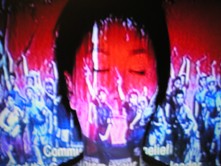
Background 7 - 31 July 2010 Place Gallery Melbourne
Art Guide Australia July/august 2010
Background 2010 video work, 23' 4''
Contemporary China, 2010, 51 x 51cm x 4, oil on linen
Quoted from Andy Warhol’s portrait of Elizabeth Taylor put together with Mao Ze Dong’s portrait to form a face. This quasi Eastern and Western face, with flowers on head and a cigarette made of US dollar in the mouth which hints the mixed body of Western and Eastern culture, and illustrates the corruption and feudal political system with the powerful Western Capitalism economy system, which creates money worship, dictator and moral degenerates.
Wink, 2010, 51 x 51 cm x 16, oil on linen
The life in a blink is influenced by traditional culture, religion, epoch and fashion, culture background fills lives with individuality. What kind of historical background forms our present individual and present society?
Berlin Wall (Deng Xiao Ping), 2010, 91.5 x 122cm, oil on linen
The Berlin wall was built in 1961 and demolished in 1989. The Berlin wall is a symbol of the division and cold war after the Second World War. The graffiti on Berlin Wall have recorded people’s desire of freedom and the division scar of Germany. The portrait of Den Xiao Ping has been repeatedly put onto the year 1989 page in “Berlin Wall Graffiti” to recall the suppression on defenceless students by the Deng Xiao Ping government in 1989 Beijing.
The Red Torch, 2010, 91.5 x 122cm, oil on linen
By inserting figure of Li Tie Mei of The Red Torch into a page of classical decorated book forms an effect of abruption. The Red Torch was a popular Beijing Opera in Cultural Revolution period. Sarcastically, implication behind the messy and luxurious decorative frame depicts simplicity and revolutionary figure. The chaos and confusion illustrates the current reality.
Modern Lure, 2010, 137. 3 x 137.3 cm, oil on linen
The three Chinese girls on the canvas represent three generations in the past century of China. That a girl leans on western style sofa in the top painting depicts the city life in the mixed culture of the East and West Shanghai during its colony period (1910-1930). The figure in the bottom-left origins from Ballet Bai Mao Girl in 1960s during the Culture Revolution, which represents the overthrowing of exploiting class by the labour army led by Mao Ze Dong, and the liberation of women. The figure in the bottom-right illustrates prostitutes serving in clubs, which represents the money omnipotent in contemporary China. The bottom painting is a Golden lilies’ placed on top of an opened book with an illustration of Western female lesbian from many of the Western paintings. The last century in China is a history of reform and tribulation, together with the introduction of Western culture such as measure of value which conflicts with the traditional Chinese Culture.

Control and been controlled, 2010, 137.3 x137.3cm, oil on linen
Images details:
- Mao Ze Dong (a book about Mao Ze Dong)
- Red guards shows loyalty to Mao in The Tiananmen Square (image from Internet)
- February, 24th 1968, South Vietnamese Army General Loan kills a suspect in public: “Buddha will understand”, he said. Page 976, Chronicle of the 20th Century, Jacques Legrand SA International Publishing, 1990
- Hitler and Mussolini (cover of a book)
- The European Powers, A.J.P. Taylor, History of the 20th Century Phoebus Publishing, 1968, page 4: European immigrants use chains to transport African slaves
- The terrified naked abused Jewish Women under the rule of German Fascists (from television)
- Zhao Zi Yang – one of the leaders that against government to use weapon on students – is using microphone to warn students flee Tiananmen Square on the day before June, 4th, 1989. (from television)
- The Boer War (South Africa, 1899-1902) A.J.P. Taylor, History of the 20th Century Phoebus Publishing, 1968, Page 15
- and 10. Pope of Catholic and his fans in Sydney, 2008 (images from television)
- Marilyn Monroe (image from Internet)


The Age, Robert Nelson
© Du chonggang 2010